Church registers of the Bulgarian Exarchate constitute an important ecclesiastical source for family history in late Ottoman Macedonia and adjacent regions. Compiled primarily in 1906–1907 across Exarchate parishes in the vilayets of Kosovo, Bitola, and Salonica, these household- and marriage-based registers document families affiliated with the Exarchate shortly before the Balkan Wars. Originals are preserved in the Central State Archives of Bulgaria (Централен държавен архив, ЦДА), while a small selection is made available online through the Strumski digital library.
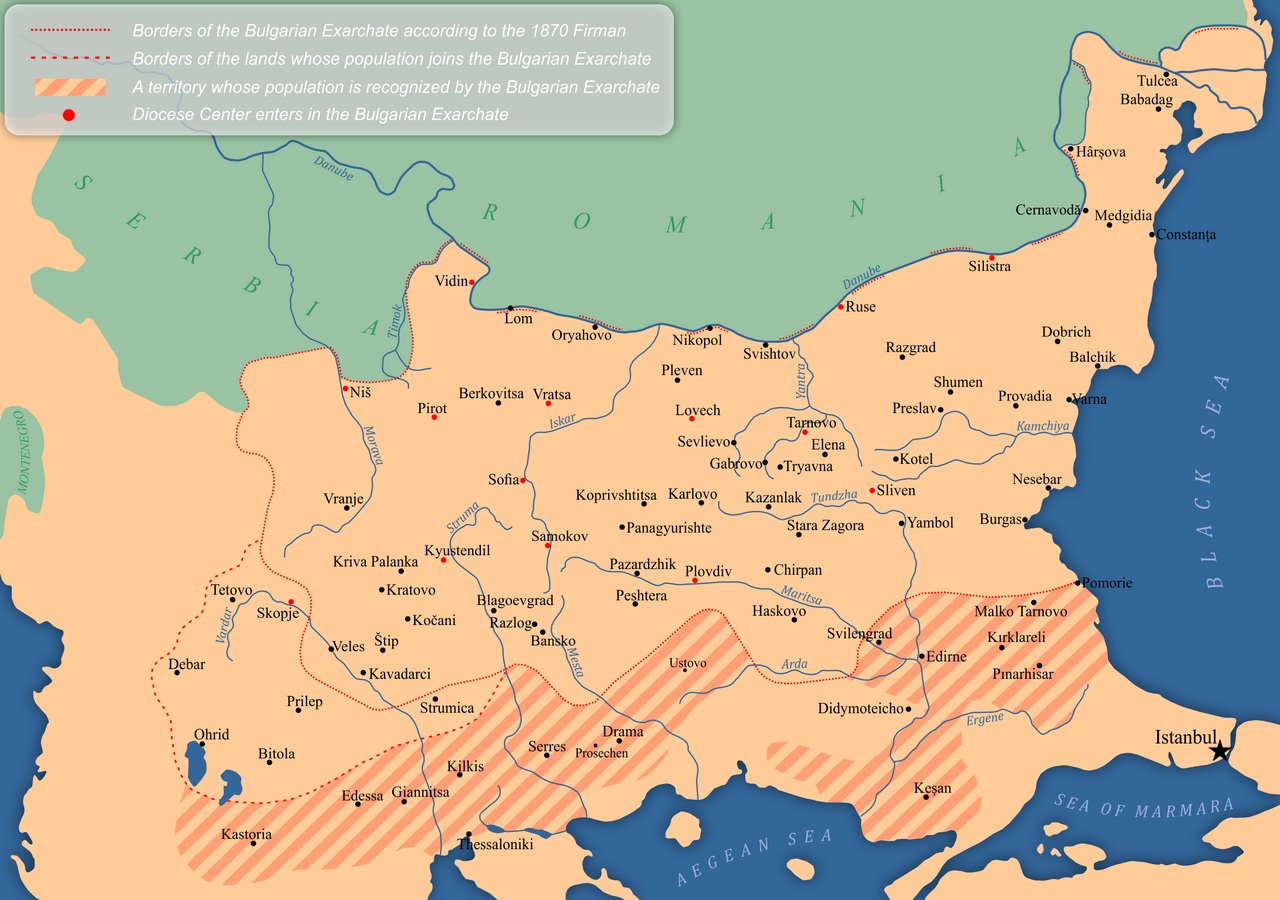
The Bulgarian Exarchate, established by imperial firman in 1870, was an autonomous Orthodox ecclesiastical institution within the Ottoman Empire. Its creation marked a shift in the religious and cultural life of the Slavic-speaking Orthodox population in Macedonia and Thrace. Beyond its spiritual role, the Exarchate functioned as a key vehicle for education, language use, and communal self-identification, operating in a space where ecclesiastical allegiance was closely intertwined with the emerging Bulgarian national project.
In Macedonia, the Exarchate competed directly with the Ecumenical Patriarchate of Constantinople, and—particularly from the late 19th century onward—with Serbian church, educational, and state-supported activities. Parish affiliation was not merely a matter of faith, but often a declaration of cultural and political orientation.
Exarchate Parish Registers (1906–1907) in the Central State Archives of Bulgaria
Address
Central State Archives (ЦДА)
5 Moskovska Street (ул. Московска № 5), Sofia, Bulgaria
Email: cda@archives.government.bg
Fond № 246K (Bulgarian Exarchate, 1870–1953) preserved at the Central State Archives of Bulgaria (Централен държавен архив, ЦДА) contains one of the most extensive surviving collections of Orthodox parish documentation from the final decades of Ottoman rule. Of particular genealogical importance are Inventory descriptions № 9 and № 10, which include parish household and marriage registers compiled primarily in 1906–1907, with some undated volumes.
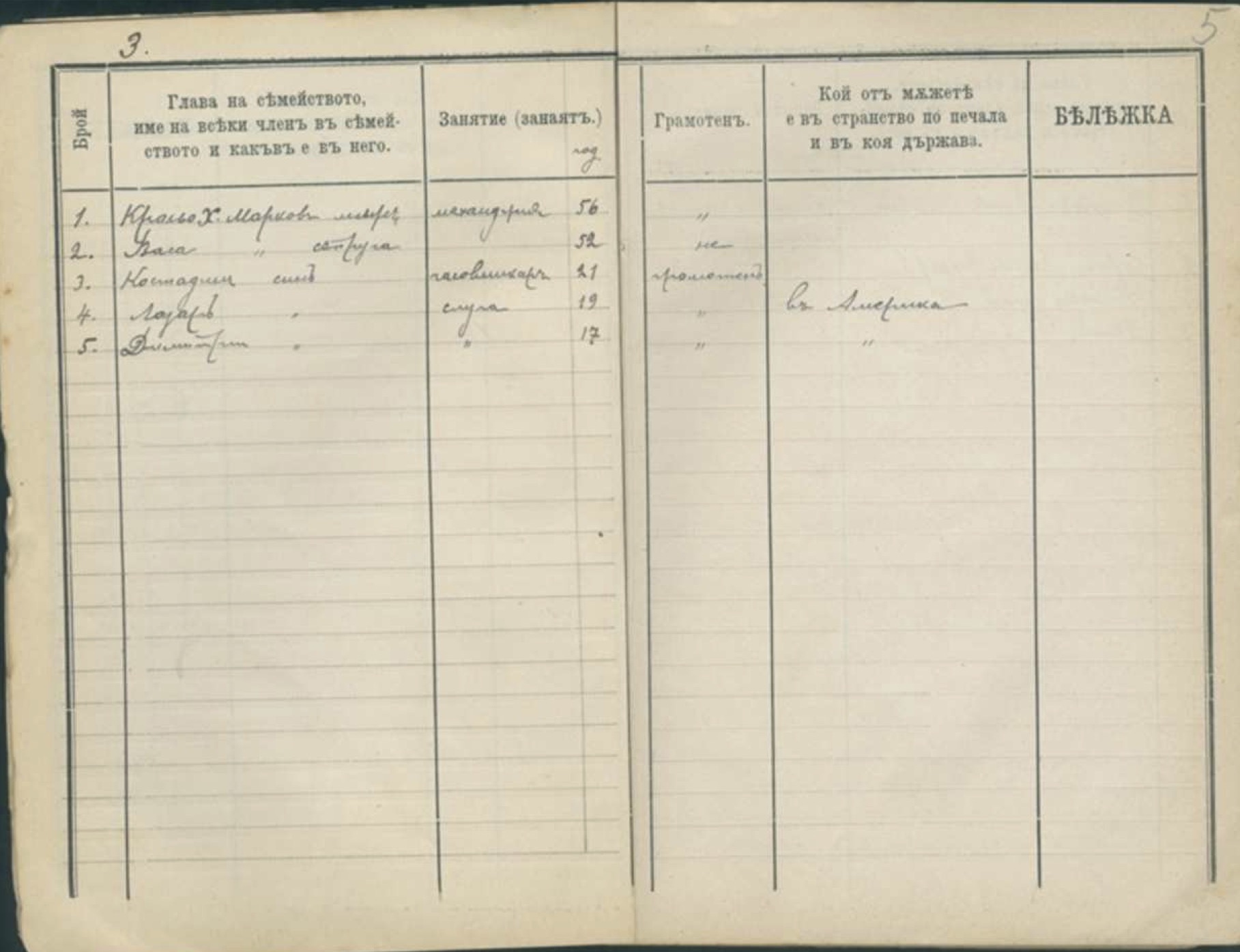
Although often titled венчила в енорията (parish marriages), these registers function in practice as comprehensive household and family lists (Libri status animarum), systematically introduced across Exarchate jurisdictions in Macedonia and adjacent regions during the early 20th century. Their format closely resembles a community census. Entries are organized hierarchically by vilayet → eparchy → kaza (district) → settlement, and typically record the head of household, all family members and their roles within the household, approximate ages, occupations or crafts, literacy, seasonal or permanent labor migration (pečalba), and additional remarks on residence, mobility, or special circumstances. This structure makes the registers exceptionally valuable for reconstructing household composition, social status, and migration patterns at the micro level.
Geographically, the registers cover Exarchate-affiliated Orthodox communities across Eastern (Adrianople) and Western (Aegean) Thrace, as well as Southern (Aegean), Western (Vardar), and Northern (Pirin) Macedonia. They span numerous Ottoman administrative units, including kazas such as Skopje, Bitola, Kostur, Lerin, Veles, Prilep, Gostivar, Tetovo, Kumanovo, Kočani, Kratovo, Pehčevo, Kukush, Serres, Petrich, Nevrokop, Razlog, and others.
It is essential to interpret these registers as confessional and institutional sources. They document households affiliated with the Bulgarian Exarchate, reflecting communities that had accepted Exarchate clergy and schooling. They are therefore not exhaustive population counts of a settlement. Absence from a register may indicate adherence to another ecclesiastical jurisdiction (Patriarchate, Serbian Orthodox Church, Uniate structures, or Islam), rather than demographic decline or migration. Inclusion reflects parish affiliation, not ethnicity in a modern national sense.
Used critically and comparatively, these registers rank among the most valuable surviving sources for genealogical, demographic, and social-historical research in late Ottoman Macedonia. They complement—but do not replace—Ottoman fiscal records, later state censuses, and parish registers of other confessions, offering a uniquely detailed snapshot of family life on the eve of the Balkan Wars (1912–1913) and the collapse of Ottoman administration in the region.
Following amendments to the Bulgarian Citizenship Act (in force since 15 March 2021), the State Archives Agency (ДАА) provides registered online access to archival inventories for individuals seeking documentation to prove Bulgarian origin. Through the Information System of the State Archives (ИСДА), users can search the inventories of Fond 246K by settlement name and identify relevant parish registers from around 1907.
Exarchate Parish Registers Online
A small selection of Bulgarian Exarchate parish registers from Fond 246K is available online via the Strumski Digital Library (Библиотека Струмски) in PDF format.
Strumski is a privately run digital library that publishes historical materials related to Macedonia and neighboring regions and presents them within a clearly articulated Bulgarian national and cultural framework. While this broader ideological context should be kept in mind, the digitized венчила themselves are direct reproductions of historical parish registers and remain highly valuable for genealogical and micro-historical research.
Skopje (Üsküb) Kaza, Kosovo Vilayet
- Skopje (city parish) by parish priest Kostadin Sveštarov, Skopje eparchy, 1907: 159 families, 685 souls, 157 houses, 353 men, 332 women, 157 literate, 528 illiterate, 6 (male) migrant workers in Bulgaria, 3 in Romania, 2 in Russia.
- Skopje (city parish) by parish priest Georgi Todorov, Skopje eparchy, 1907: 269 families, 1185 souls, 225 houses, 593 men, 592 women, 450 literate, 9 (male) migrant workers in Bulgaria, 5 in Romania, 4 in America, 1 in Austria, 1 in Germany.
- Skopje (city parish) by parish priest Lazar D. Organdžiev, Skopje eparchy, 1907: 235 families, 1089 souls, 229 houses, 554 men, 535 women, 343 literate, 9 (male) profiteers in America, 8 in Romania, 5 in Bulgaria, 3 in Austria and 2 in Serbia.
- Skopje (city parish) by parish priest Panko Popdimitrov Sveštarov, Skopje eparchy, 1907: 235 families, 1089 souls, 229 houses, 554 men, 535 women, 343 literate, 9 (male) profiteers in America, 8 in Romania, 5 in Bulgaria, 3 in Austria and 2 in Serbia.
- Skopje (city parish) by parish priest Atanas Stankov, Skopje eparchy, 1907: 1555 souls, 279 houses, 7 (male) migrant workers in America, 6 in Romania, 4 in Bulgaria, 3 in Serbia, 1 in Austria.
- Skopje and environs (Madžari, Sarajsko Orizari, Saraj, Zlokukjane, Jurumleri, Butel, Indžikovo, Trubarevo, Matka) by parish priest Angel K. Daskalov, Skopje eparchy, 1907: 202 families, 776 souls, 383 men, 393 women, 0 literate, 776 illiterate, 2 migrant workers in Serbia, 1 in Bulgaria.
Gostivar Kaza, Skopje Vilayet
- Vrutok by parish priest Arkadij pop Tomov, Skopje eparchy, 1906: 47 houses, 72 marriages, 282 souls. On a side note: In 1909, parish priest Arkadij petitioned the Ottoman Parliament against the state-authorized opening of a Serbian school and the introduction of alternating church services in Vrutok, a village he described as “entirely Bulgarian”, despite fifteen households identifying as Serbs (“сърбомани“) during the census.
- Mavrovo by parish priest Trajko Ugrinov, Skopje eparchy, 1906: 28 houses, 44 marriages, 168 souls.
Murtino municipality, Strumica region
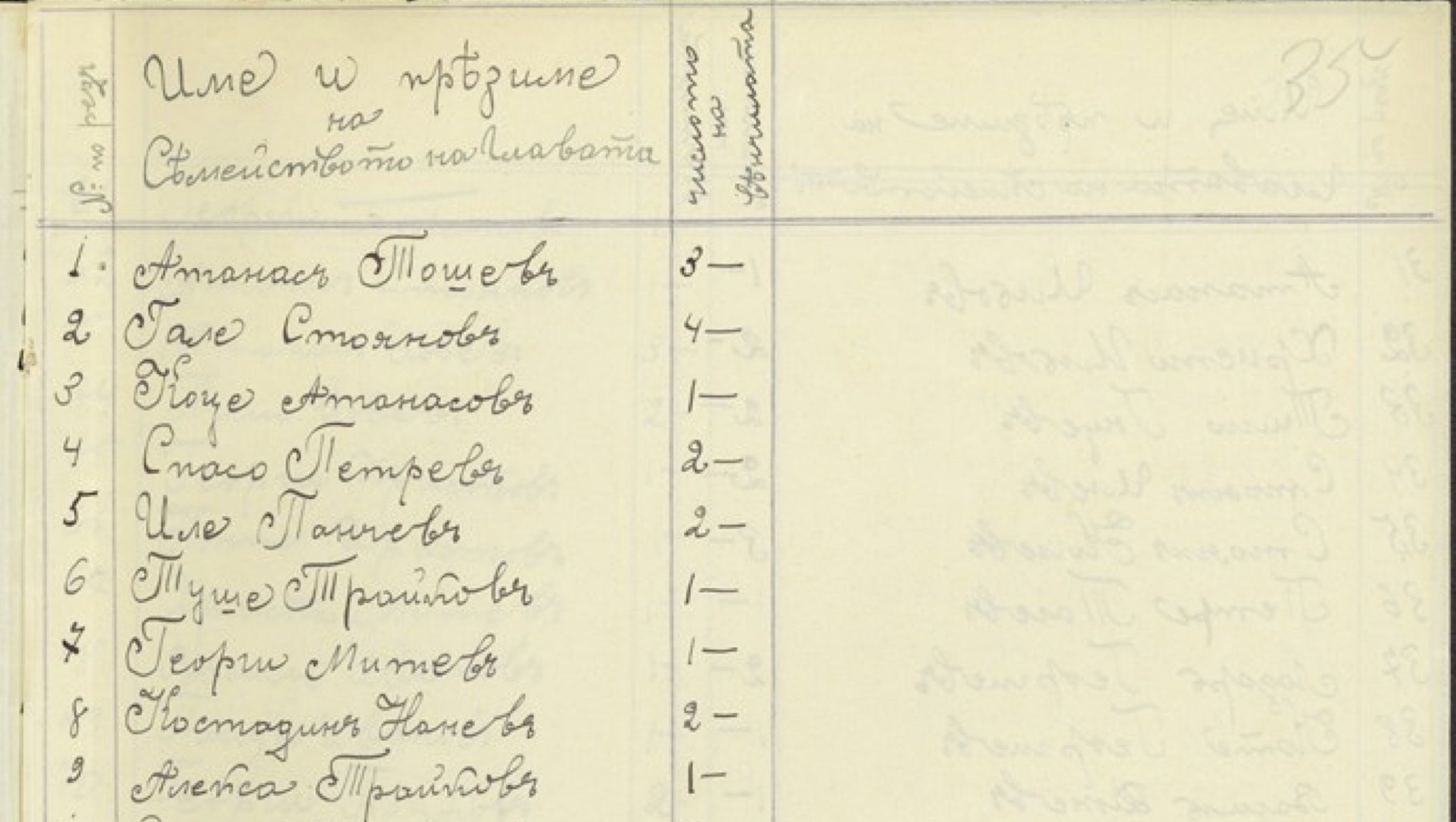
- List of Christian households in the Murtino municipality (villages of Murtino, Baldovci, Bansko), sent by mayor Nikola Timov Azmanov to the Bulgarian Metropolitan Gerasim of Strumica on 25 April 1914, during the Bulgarian rule after the Balkan Wars.
Kastoria (Kostur) Kaza, Bitola Vilayet
- Hrupišta (Argos Orestiko) & Ezerec (Petropoulaki) by parish priest Hristo Dimitrov, Kastoria eparchy, 1907. Hrupišta: 270 souls, 46 houses, 13 male migrant workers in Bulgaria, 7 in America. Ezerec: 208 souls, 33 houses, 1 migrant worker in Bulgaria.
- Vrbnik (Vernik, Korça region) by parish priest Dimitar Ivanov Sinčov, Kastoria eparchy, 1907: 453 souls, 101 houses. Men abroad (mostly carpenters): 25 in Bulgaria, 18 in Anatolia, 13 in America, 12 in Greece, 7 in Bilishta, 3 in Dedeağaç, 2 in Arabia, 2 in Thessaloniki, 1 in Morea.
- Blaca (Oxya) by parish priest Kostadin (Dino) pop Kuzov, Kastoria eparchy, 1906: 340 souls, 96 houses.
- V’mbel (Moschochori) by parish priest Vasil Georgiev Duljov, Kastoria eparchy, 1906: 670 souls, 170 houses.
- Črnovišta (Mavrokampos) by parish priest Naum Filipov, Kastoria eparchy, 1906: 330 souls, 92 houses.
- Aposkep (Aposkepos) by parish priest Teohar Zhelezkov, Kastoria eparchy, 1906: 433 souls, 109 houses.
Lerin (Florina) Kaza, Bitola Vilayet
- Gorno Vrbeni (Xino Nero) by parish priest Ivan Sterjov Markuzev, Moglena eparchy, 1907: 687 souls, 169 houses. Men abroad: 101 in America, 25 in Constantinople, 4 in Bulgaria, 2 in Bitola, 1 in Romania.
- Gorno Vrbeni (Xino Nero) by parish priest Jovan Trifonov, Moglena eparchy, 1907: 646 souls, 163 houses. Men abroad: 88 in America, 24 in Constantinople, 8 in Bulgaria, 7 in Romania, 3 in Thessaloniki, 2 in Bitola prison, 1 in Bitola, 1 in Çanakkale, 1 in Fezzan, 1 priest in Surovičevo.
- Zeleniče (Sklitro) by parish priest Georgi pop Teodorov, Kastoria eparchy, 1906: 473 souls, 94 houses.
- Setina (Skopos) by parish priests Vasil, Ivan and Trajan, Lerin eparchy, 1906: 760 souls, 192 households.
Doiran Kaza – Salonica Vilayet
- Akandžali (Mouries, Kukuš/Kilkis region) by parish priest Hristo Trajkov, Polyanin eparchy, 1906: 315 soulls, 72 houses.
- Akandžali (Mouries, Kukuš/Kilkis region) by parish priest Dimitar (Mito) Gjuzelev, Polyanin eparchy, 1906: 247 souls, 60 houses.
Demir Hisar Kaza – Salonica Vilayet
- Todorič (Todoritsi, Valovišta/Sidirokastro region) by parish priest Stoyan Petrov, Melnik eparchy, 1906: 83 souls, 24 houses.
Last edited: 18.01.2026.
 Ex-Yu Genealogy