Roman Catholic parish registers constitute one of the oldest, most continuous, and genealogically richest sources for the study of population history and family lineages in Bosnia and Herzegovina. Their preservation and early development are inseparably linked to the region’s specific historical context, particularly the centuries of Ottoman rule (15th–19th centuries), during which Catholics existed as a legally tolerated but socially subordinate religious community.
Following the decrees of the Council of Trent (1545–1563) and the Roman Ritual of 1614, the Catholic Church mandated the systematic recording of baptisms (Liber baptisatorum), marriages (Liber copulatorum), and burials (Liber defunctorum), later supplemented by confirmations (Liber confirmatorum) and household censuses (Liber status animarum). In Bosnia and Herzegovina, the consistent application of these norms was achieved almost exclusively through the Franciscan Order, especially the Province of Bosna Srebrena, whose friars functioned as parish priests, educators, chroniclers, and long-term custodians of communal memory.
Despite operating under difficult and often dangerous conditions, Franciscan friars began keeping parish registers remarkably early. The oldest preserved Catholic parish register in Bosnia and Herzegovina dates from 1641 and is held at the Franciscan Monastery of Kraljeva Sutjeska, with largely continuous series extending over three centuries. Other early survivals include Vareš (17th century), Jajce (baptisms from 1719), Ivanjska (from 1729), and Skopje / Uskoplje (from 1745–1753). More regular and standardized record-keeping is closely associated with the establishment of the Bosnian Apostolic Vicariate in 1735, particularly during the episcopate of Bishop fra Pavao Dragićević (1740–1768).
Many registers, especially earlier volumes, were lost through warfare, fires, forced relocations, confiscations, or deliberate destruction—most notably in the 17th century, during the Second World War, and again during the conflicts of the 1990s. In some cases, only fragments survive. For example, the ancient parish of Rama (Šćit) lost most of its original registers in July 1942; preserved fragments include baptisms (1744–1747) and burials (1746–1748), today kept in the Franciscan Monastery in Fojnica. Later registers survive only in transcript form from 1884 onward.
The registers were written primarily in Latin, vernacular Croatian, and occasionally Italian, using Latin script; many 18th-century volumes—especially those kept by Franciscans—were written in bosančica (Bosnian/Croatian Cyrillic). Early entries frequently lack fixed hereditary surnames, identifying individuals instead by patronymics, nicknames, places of origin, or occupations. Over time, these descriptors stabilized into permanent surnames, making the registers indispensable for tracing surname formation, family continuity, demographic change, and migration patterns.
Today, Roman Catholic parish registers in Bosnia and Herzegovina are dispersed among parish offices, Franciscan monasteries, diocesan and archdiocesan archives, and, in some cases, state archives. Access policies vary, but a growing number of registers have been edited, transcribed, and published, significantly expanding their availability for genealogical and historical research.
Published Parish Registers and Family Reconstructions
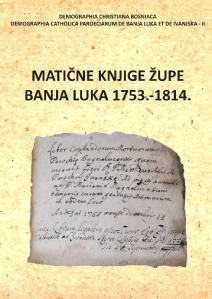
A major contribution to accessibility has been made through the publication of edited parish registers and systematic family reconstructions, especially within the scholarly series Demographia Christiana Bosniaca, which presents critically transcribed Catholic church books from Bosnia and Herzegovina.
Notable volumes include:
-
Matična knjiga umrlih Župe Fojnica 1750–1821, edited by Anto Ivić and Marko Ćorić, presents the death register (Liber defunctorum) of the Fojnica parish.
-
Matične knjige Župe Banja Luka 1753–1814, edited by Anto Ivić, presents the registers of baptisms, marriages, and burials.
-
Matične knjige Župe Ivanjska 1729–1779, edited by Anto Ivić, is one of the earliest continuous parish series from Ivanjska parish near Banja Luka.
Closely related is the series Demographia Catholica Scopiensis, dedicated to the historic Uskoplje (Gornji Vakuf) region. Published volumes include:
These volumes cover the parishes of Skopje (seat in Voljice and Bistrica until 1806), Skopje Gornje (Gornji Vakuf), Malo Selo (Bugojno), and Golo Brdo (Kandija). The registers were written in bosančica and Latin and include individuals from Kupres, Duvno, Livno, Rama, and parts of Dalmatia.
 Additional important published parish registers include:
-
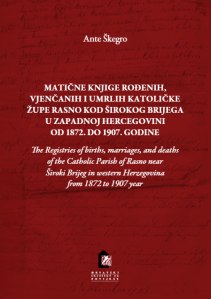
Matične knjige rođenih, vjenčanih i umrlih Katoličke župe Rasno kod Širokog Brijega u zapadnoj Hercegovini od 1872. do 1907. godine, edited by Ante Škegro (Zagreb: Hrvatski institut za povijest, 2024). This book presents birth, marriage, and death registers of the Rasno parish near Široki Brijeg, covering 1872–1907. The historical parish included the villages Rasno, Dužice, Buhovo, Kosmaj, Grljevići, Ledinac, Medvidovići, and Višnjica, later subdivided into the parishes of Grljevići (1919), Ledinac (1930), and Buhovo (1969).
In addition to edited parish registers, several large-scale Bosnian Croat family reconstructions based on parish records and episcopal censuses have been published:
-
Katolički rodovi župe Fojnica 1742–1992, by Milo Jukić. This is a comprehensive reconstruction of Catholic families in the Fojnica area over 250 years.
-
Katolički rodovi župa Kreševo, Lepenica (Banbrdo), Kiseljak i Deževice 1742–1992, by Milo Jukić. These family reconstructions are based on episcopal censuses of 1742 and 1768, parish registers from 1765–1992, and extensive field research.
Last edited: 08.01.2026.
 Ex-Yu Genealogy