Systematic parish record-keeping among the Serbian Orthodox population of Bosnia and Herzegovina began relatively late compared to Roman Catholic areas. The earliest preserved Orthodox parish registers date from the mid-19th century, when local circumstances under Ottoman rule first allowed more stable ecclesiastical administration. Wider and more consistent record-keeping was introduced only after 1878, under Austro-Hungarian administration, when parish registers became legally regulated and standardized.
In Sarajevo’s Old Orthodox Church on Baščaršija, registers of baptisms, marriages, and deaths begin in 1855, while Brčko preserves baptismal registers from 1852 and marriage and burial registers from the 1860s. Isolated evidence nevertheless indicates earlier record-keeping in some parishes: travel accounts from the 1840s describe church registers already in use in Herzegovina, by the St. Nicholas parish in Trijebnje near Stolac, suggesting that pre-1850 registers once existed but were later destroyed.
After 1878, under Austro-Hungarian administration, parish registers became legally regulated and standardized. From this period onward, most Orthodox parishes gradually began keeping separate registers of baptisms, marriages, and deaths, often accompanied by домовници (household registers), which recorded entire households and today represent one of the most valuable sources for Orthodox genealogical reconstruction. Ecclesiastical correspondence from the late 19th century, however, shows that implementation was uneven: some parishes lacked proper books for years, others failed to record events systematically, and clergy struggled with German-language administrative forms. The result, still visible in surviving parish series across Bosnia, is a pattern of delayed starts, partial runs, and uneven coverage well into the early 20th century.
The survival of Orthodox church registers has been profoundly shaped by war, persecution, and state intervention. Large numbers of parish books were destroyed during the Second World War, when Ustaša genocidal violence led to the burning of churches and parish houses and the annihilation of entire communities. Further catastrophic losses occurred during the 1992–1995 war, most notably the complete destruction of the centuries-old archival holdings of the Orthodox Diocese of Zahumlje–Herzegovina in Mostar in June 1992, when the library and archives containing the Mostar church registers were burned. In addition, after 1945 many parish registers were confiscated by Socialist authorities for transfer into civil registry offices, though a significant number were eventually returned—sometimes only decades later.
Today, Serbian Orthodox parish registers in Bosnia and Herzegovina are not held in a single central archive. Many remain at the parish level, accessible only through direct contact with the local priest. Others have been concentrated in diocesan or state archives, especially where wartime evacuation or postwar preservation efforts made this necessary. A few collections, which are presented in more detail below, are of particular importance for researchers:
-
The Serbian Orthodox Parish of Sarajevo collection, preserved from the Old Orthodox Church and associated parishes. Covering vital registers from the mid-19th century onward and including extensive домовници and auxiliary records, it is partially digitized and accessible online through FamilySearch.
-
The Archives and Library of the Serbian Orthodox Diocese of Zvornik–Tuzla in Bijeljina preserve a regional collection of parish registers, household books, and church court records from northeastern Bosnia, with especially strong coverage for Tuzla, Gračanica, and surrounding parishes. These materials remain largely accessible on site, with gradual digitization underway.
Taken together, these collections illustrate both the fragility and the exceptional genealogical value of Serbian Orthodox church records in Bosnia and Herzegovina.
Serbian Orthodox Parish of Sarajevo (FamilySearch)
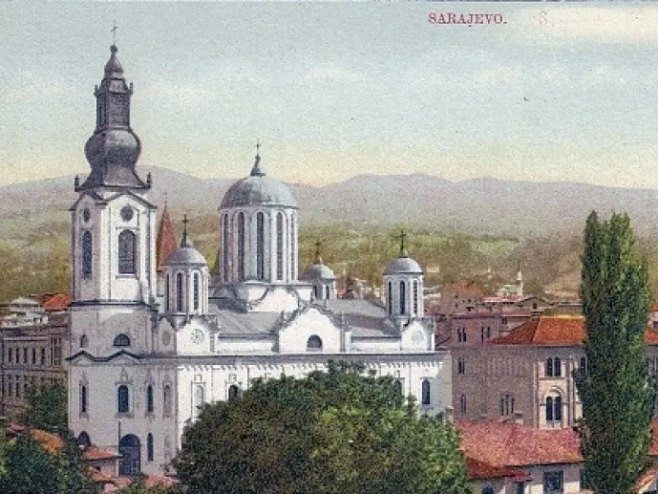
The FamilySearch collection Bosnia and Herzegovina, Sarajevo, Serbian Orthodox Church Books, 1300–2012 represents one of the most complete and methodologically valuable body of Orthodox genealogical sources in Bosnia and Herzegovina. The core registers of the Archangels Michael and Gabriel parish in Sarajevo begin in the mid-19th century, with systematic recording from 1854 onward.
Vital registers from the Old Orthodox Church (Стара Саборна црква) and the Cathedral of the Nativity of the Mother of God (Саборна црква Рођења Пресвете Богородице) in the old city centre, and the Church of the Holy Transfiguration (Храм Преображења Господњег) in Pofalići suburb, include:
-
Baptisms: 1854–2011 (with indexed series 1854–1949)
-
Marriages: 1854–1961 (with extended coverage in surrounding parishes)
-
Deaths: 1854–1965 (supplemented by extensive cemetery registers)
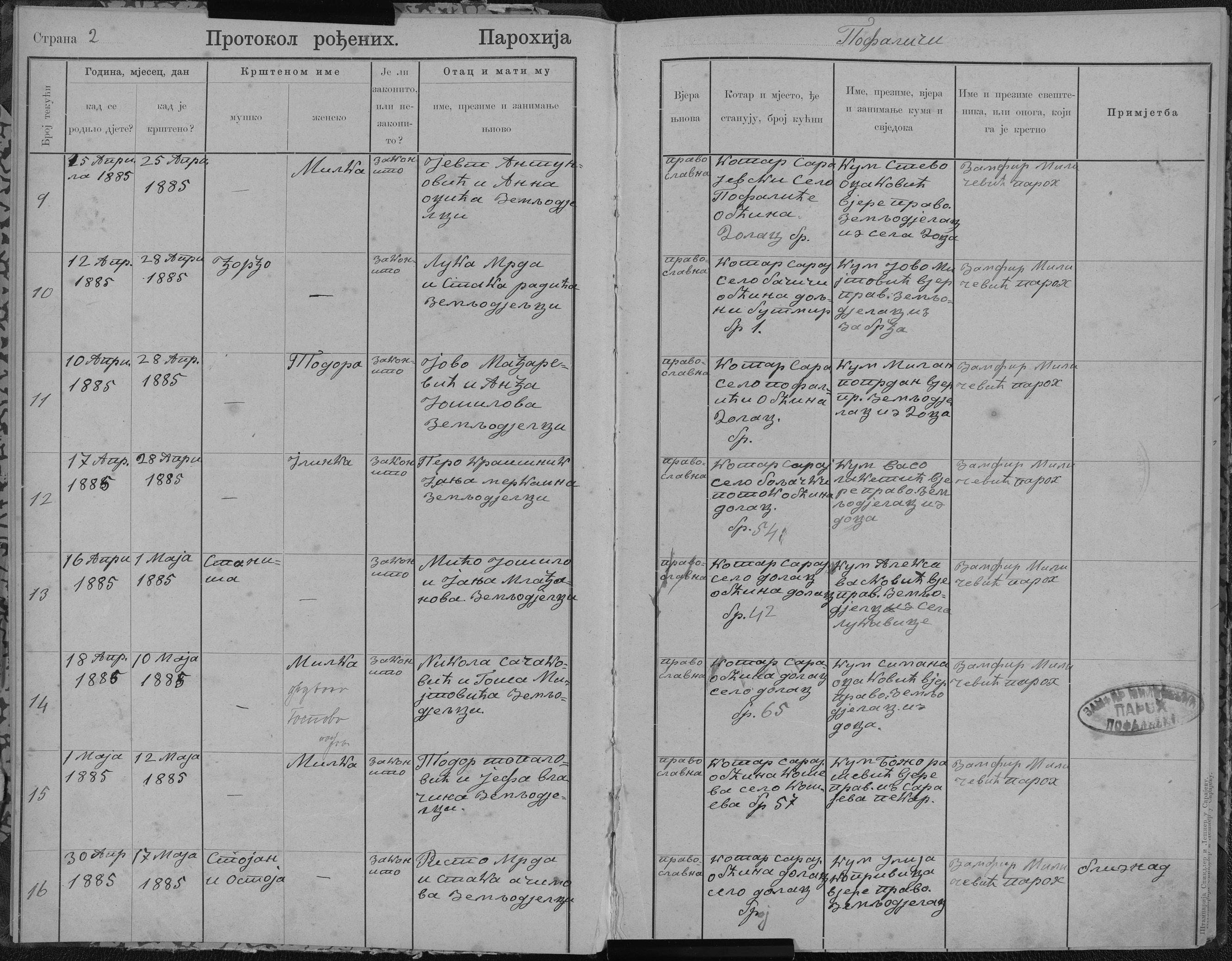
A uniquely valuable component of the collection is the presence of домовници (household registers), primarily dating from the late 19th century through the mid-20th century, together with related parish documentation, enabling full multi-generational family reconstructions.
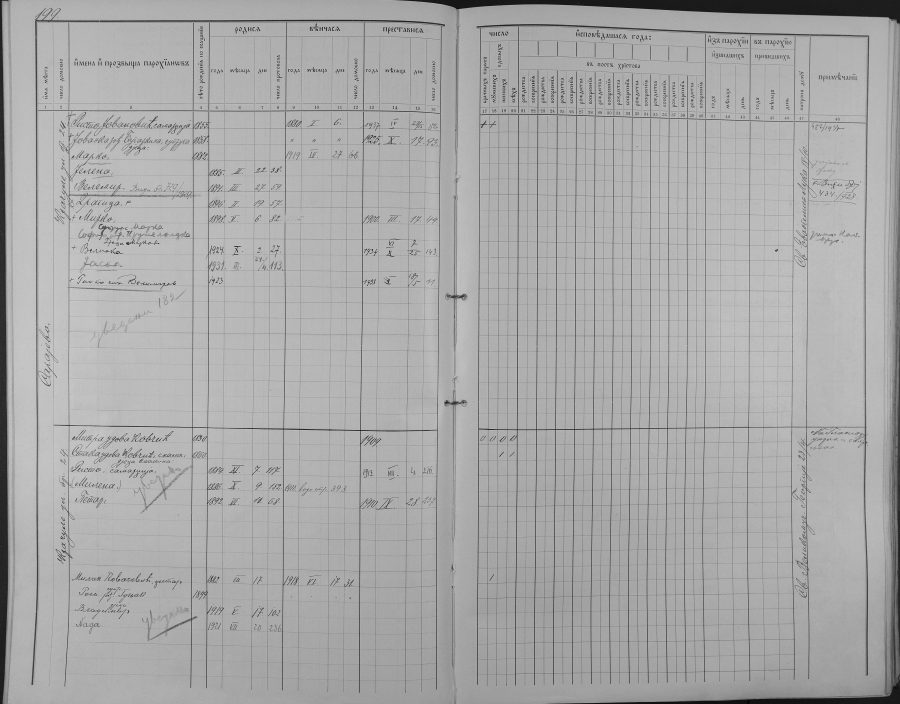
The collection also covers suburban and rural parishes tied administratively to Sarajevo, with births, marriages, and deaths extending from the late 19th century into the early 21st century, notably:
- Novo Sarajevo (Dolac) (births, 1885-2008; marriages, 1901-1986; deaths, 1885-1996),
- Blažuj (births, 1900-2000; marriages, 1900-1999; deaths, 1885-1986),
- Pazarić (births, 1946-1994; marriages, 1885-1969; deaths, 1885-1991; censuses, 1900, 1930-1969), and
- Hadžići (births, 2000; deaths, 1991-2014).
Additional genealogically rich materials include cemetery registers, some predating parish vital books, premarital examination protocols (1925–1947), often naming parents and places of origin, conversion records (1930-1990), parish ministry books, and hospital registers.
Archives and Library of the Diocese of Zvornik-Tuzla
Address: Ulica Patrijarha Pavla 40, 76300 Bijeljina, Bosnia and Herzegovina
Telephone: +387 55 222 300
Email (Diocese): ep.bn@teol.net
Email (Archive & Library): arhiv.epzt@gmail.com
Responsible archivist / library contact: Protodeacon Lazar Ilić
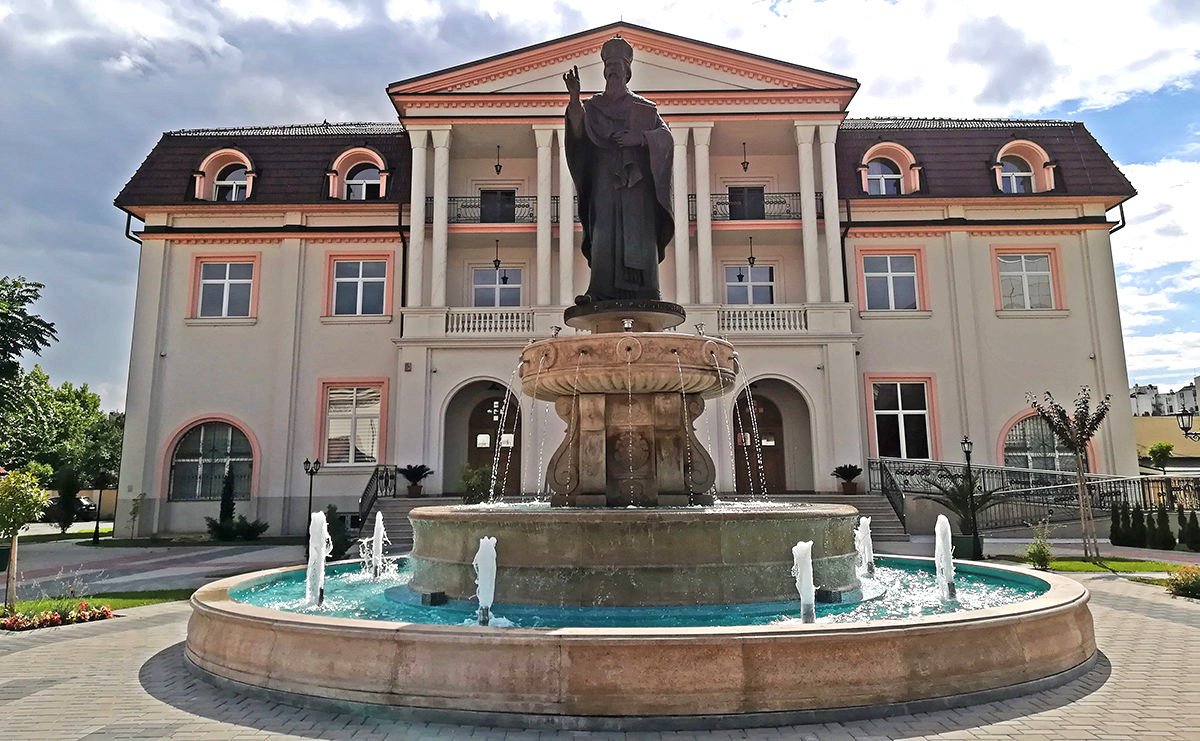
The Archives and Library of the Serbian Orthodox Diocese of Zvornik-Tuzla in Bijeljina preserves one of the most important regional collections of Orthodox parish registers and household documentation for northeastern Bosnia and Herzegovina. Its holdings are especially strong for Tuzla and its surrounding parishes, reflecting Tuzla’s historical role as a major ecclesiastical and administrative center of the diocese.
The earliest preserved Orthodox parish registers in the collection originate in the Serbian Orthodox parish of the city of Tuzla, where systematic recording of baptisms, marriages, and deaths begins in 1862 and continues, with varying completeness, through the 20th century. These foundational registers—kept in their earliest decades by the Tuzla parish priest Cvijetin Popović—form the backbone of Orthodox genealogical research for Tuzla and parts of northeastern Bosnia. Surviving Tuzla series include baptisms (1862–1935), marriages (1862–1946), and deaths, providing a continuous mid-19th-century starting point comparable in chronological depth to Sarajevo’s Orthodox registers.
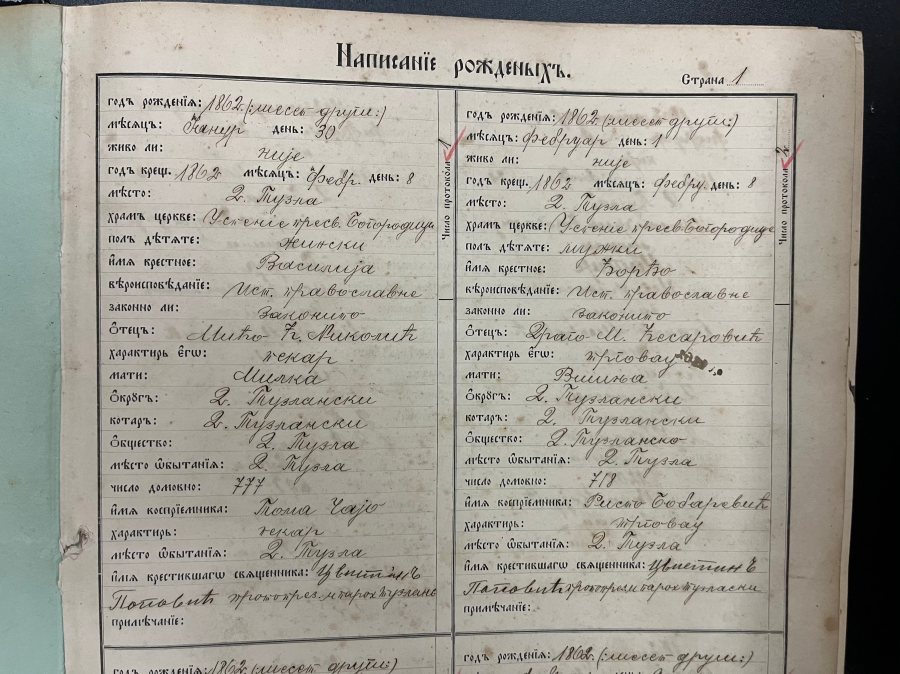
Within the diocesan archive, the parishes of Tuzla, Gračanica, and Puračić together constitute the most complete and methodologically valuable cluster of sources. Gračanica complements the Tuzla core with long-running death registers (1920–1987) and preserved домовници (household registers), enabling intergenerational linkage well into the late 20th century. The village parish of Puračić is particularly rich due to its combination of baptismal registers (1914–1947), marriage registers (1905–1913; 1958–1994), and extensive домовници (1914–1950), allowing for unusually detailed family reconstructions across multiple decades.
Beyond these core parishes, the archive preserves parish registers from a broad geographic range across northeastern Bosnia, including:
- Bukvik (marriages and deaths, 1895-1917),
- Bijela (marriages, 1895-1933),
- Požarnica (Mt. Majevica),
- Kožuhe (near Doboj) (marriages, 1896-1925; deaths, 1896-1935),
- Skipovac (near Doboj) (deaths, 1897-1925), and
- the Ozren Monastery (births, 1905-1912).
Coverage generally spans the late 19th century through the early to mid-20th century, with some series covering the late Socialist period and, in a few cases, the early 1990s—for instance, Jasenica (near Srebrenik) (deaths, 1946-1968), and Kladanj (marriages, 1985-1988; deaths, 1984-1991).
A particularly valuable component of the collection is the presence of домовници (household registers) for multiple parishes, including Tuzla (1974-1983), Gračanica, Puračić (1914-1950), Bijeljina, Janja (1912-1925), Tumare (near Lukavac), Crnjelovo (1936-1941), Vozuća (1975-1993), and Cikote (1976-1978).
Mostly dating from the early 20th century through the postwar period, these registers record entire households over time and enable full multi-generational family reconstructions, often bridging gaps caused by missing, damaged, or confiscated vital registers.
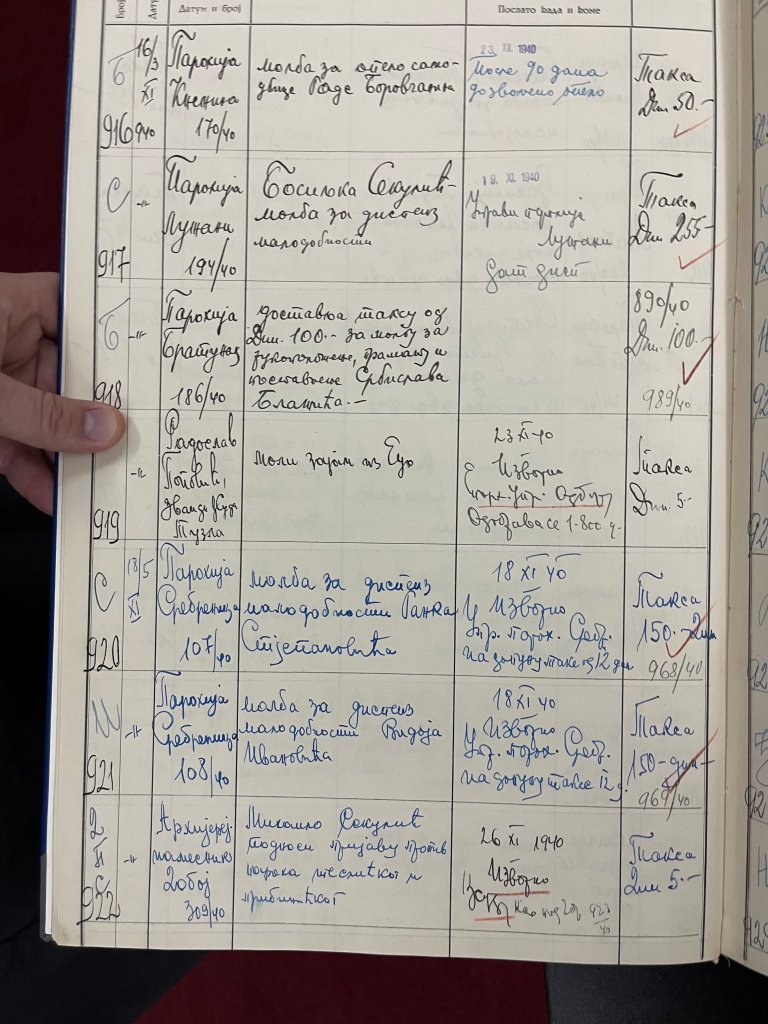
In addition to standard parish books, the archive preserves church court protocols (протоколи црквених судова), a source of high genealogical interest. These frequently include episcopal dispensations (епископско разрешење)—for example, permissions for marriages involving underage spouses—and often contain detailed personal data, kinship relationships, and places of origin.
Historically, many of these church books were housed at diocesan offices in Tuzla until the outbreak of the 1992–1995 war, when the entire archival collection was transferred to Bijeljina, now the permanent seat of the diocese. The diocese maintains in-house digitization capabilities, and the scanning of parish registers and household books is progressing gradually.
Genealogical research is possible upon written request to the archive. The diocese staff—including the protodeacon responsible for the collection—can also facilitate contact with local parishes, where many other church registers are kept, and with local historians knowledgeable in village- and regional-level history. This makes the archive not only a repository of records but also a key entry point for contextual Serbian Orthodox family research in northeastern Bosnia and Herzegovina.
- Please note: several parish registers from Požarnica (1879–2002), Cviljevina (1879–1977), Kovačevo Selo (1879–1976), Kolimer (1879–1976), and Potraš (1879–1976) are preserved and accessible at the Archives of Tuzla Canton.
 Ex-Yu Genealogy