Family names across the post-Yugoslav region developed and stabilized at different times, reflecting diverse historical administrations, religions, and social structures. While some areas adopted hereditary surnames as early as the medieval or early modern period, others fixed family names only in the 19th or even 20th century through state reforms. As a result, surnames may indicate patronymic origins, clans, occupations, or places of origin. This guide gathers key tools and sources to help researchers interpret these regional naming traditions and trace family lineages more accurately.
Slovenia
Coming soon.
Croatia
More coming soon.
Bosnia & Herzegovina
Surnames in Bosnia and Herzegovina are passed patrilineally. Development and stabilization varied by ethnicity and historical rule—earlier hereditary forms among Croats, mid-19th-century fixing among Serbs, and Ottoman-influenced adaptations or name changes among Bosniaks—with overall patterns paralleling neighboring Croatia and Serbia.
-
More about Bosnian & Herzegovinian Family Names & Lineages (coming soon)
Serbia
Serbian surnames are overwhelmingly patronymic (ending in -ić / -ević / -ović), evolving from earlier Slavic practices but only standardized and made hereditary in the Principality of Serbia in 1851; the 1854 census first recorded the population by these fixed (“frozen”) surnames.
Prior to this, ordinary people typically used only given names plus temporary patronymics. In parts that were liberated from Ottoman rule only later, surnames are a phenomenon that stabilized even later, sometimes not until the course of the 20th century.
More coming soon.
Montenegro
Montenegrin surnames are primarily patronymic, toponymic, or derived from clans (bratstva), tracing ancestry to a founding ancestor. Like in Serbia, they transitioned from fluid patronymics to fixed hereditary family names around the mid-19th century under princely administration and modern state registration.
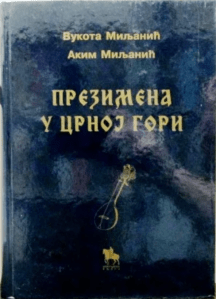 ◘ Prezimena u Crnoj Gori (Beogradska knjiga, 2002/2007) by Vukota and Akim Miljanić is the most comprehensive study of Montenegrin surnames published to date. This printed monograph documents nearly 14,000 surnames, exploring familial connections and surname histories across Montenegro. It remains a cornerstone reference for genealogists and onomastic researchers.
This printed monograph documents approximately 14,000 surnames, drawing on historical records, ethnographic research, and earlier works such as those by Jovan Erdeljanović (1910). It is available as a secondhand physical book, though two online surname registries draw on this work as a primary sources of information, notably:
◘ In addition, Montenegrin genealogical research often relies on published studies of tribes and clans, which document kinship structures, settlement patterns, and lineage traditions that predate systematic recordkeeping.
Kosovo and Albania
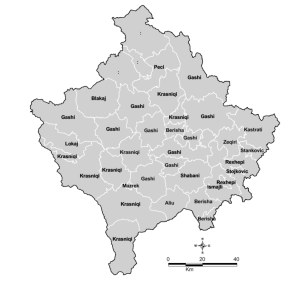 Albanian and Kosovar family names reflect centuries of history, migration, tribal structures, and cultural identity. Many surnames indicate ancestral origins, occupations, physical traits, or clan affiliations, particularly in northern Albania and Kosovo, where historic tribal networks have strongly influenced family lineages.
In Albania, surnames (mbiemri) underwent major state-driven stabilization and alteration in the communist period (1966 decree and 1975 mandate) to eliminate religious elements and enforce “pure” Albanian forms.
-
More about Albanian and Kosovar Family Names & Lineages
North Macedonia
Most Macedonian surnames derive from three primary sources: personal names, nicknames, and occupational or descriptive terms. Patronymic formation is particularly dominant, reflecting earlier naming practices in which individuals were identified through their father or ancestor.
Macedonian surnames are most commonly formed with suffixes such as -ski / -evski / -ovski, originally indicating belonging, origin, or descent. During the 19th century, these forms became increasingly common, especially in western Macedonia.
Hereditary surnames became gradually stabilized during the 19th and early 20th centuries under changing Ottoman, Serbian, Bulgarian, and later Yugoslav administrations, which sometimes altered or standardized surname endings in official records.
- More about Macedonian Family Names & Lineages
Last edited: 21.03.2026
 Ex-Yu Genealogy