Albanian family names and lineages reveal a rich tapestry of history, culture, and kinship. Across Albania and Kosovo, surnames carry traces of geographic origins, occupations, descriptive traits, and tribal affiliations. In northern Albania and parts of Kosovo, historic tribal structures (fis) shaped extended family networks and community life, leaving a lasting imprint on surnames still common today.
Genealogical research in the region draws on multiple sources: ethnographic and tribal studies, historical records, modern census data, and oral family histories. Understanding the social and historical context of surnames is essential, as the same surname may appear across multiple regions and among unrelated families, reflecting shared tribal or cultural identity rather than direct kinship.
This subpage presents a selection of key studies that together offer a detailed view of Albanian and Kosovar surnames, providing context for genealogists, etymologists, and anyone tracing family histories in Albania, Kosovo, and the wider Albanian diaspora.
Robert Elsie, The Tribes of Albania (I.B. Tauris, 2015)
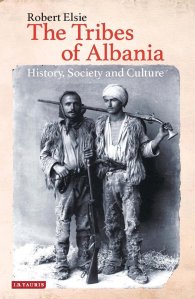 For anyone researching Albanian genealogy, Robert Elsie’s The Tribes of Albania (I.B. Tauris, 2015) is an essential reference. This pioneering scholarly work is the first detailed study of the tribal societies that once dominated Northern Albania, Montenegro, and parts of Kosovo. These tribal structures—based on kinship, extended family networks, and clan allegiance—thrived until the early 1900s and were largely intact when the communist regime seized power in Albania in 1944.
Although the half-century of totalitarian rule significantly weakened or eradicated many of these traditional structures, the north of Albania remains culturally distinct from the more urbanized south. Elsie’s book provides a comprehensive survey of 69 different tribes, documenting their locations, population, religious affiliations, internal structures, customs, folklore, and inter-tribal relations. He also draws on nineteenth- and early-twentieth-century travel writers—such as Edith Durham, Baron Franz Nopcsa, Johann Georg von Hahn, and Karl Steinmetz—who explored the region and recorded aspects of its social and cultural life. Short biographies of prominent tribal figures further enrich the text.
For genealogists, the book is invaluable for understanding the broader social and tribal context of Albanian surnames, particularly in northern Albania and adjacent Kosovo. Many Kosovar Albanian surnames reflect historic clan (fis) affiliations that Elsie details, such as Krasniqi, Gashi, Berisha, Shala, Hoti, and Kelmendi. Understanding these tribal roots is crucial for tracing lineage and making sense of surname distribution across regions.
However, it is important to note that Elsie’s work does not provide deep, specific kinship links between families in Kosovo and those in northern Albania. While it richly documents tribal structures, customs, and historical background, genealogists seeking precise family connections will need to combine this tribal knowledge with local records, family oral histories, and surname studies. In this sense, The Tribes of Albania serves as a contextual and cultural guide, rather than a source of individual family trees, but it remains an indispensable starting point for anyone exploring Albanian ancestry.
Available through Amazon.
Origins and Regional Distribution of Kosovo Albanian Surnames (2015)
The study ‘Prejardhja dhe Shpërndarja Rajonale e Mbiemrave të Shqiptarëve të Kosovës’ by Ali and Nebi Caka (Studime shoqërore 3, 2015) provides a comprehensive overview of surname origins and regional distribution among Albanians in Kosovo, offering an invaluable starting point for genealogical research. Albanian surnames largely emerged under Ottoman rule, and were formalized after the independence of Albania in 1912. In Kosovo, the situation was complicated by the Yugoslav period, when authorities often forced Albanian families to add Slavic suffixes such as -iq or -viq to their surnames (e.g., Cufa became Cufiq, Hasani became Hasanoviq). After World War II, Kosovars regained the right to restore or change surnames, with many families returning to their original Albanian forms or adopting entirely new ones. Changes continued even after the 1999 conflict, reflecting evolving family and personal identities.
The research is based on an extensive examination of population registers, covering approximately 1.5 million individuals, as well as surveys of adults aged 24 to 70. Participants provided information about their family names, origins, and sometimes traced their lineage up to 15 generations.
Kosovar Albanian surnames generally fall into five categories:
- Patronymic surnames, derived from an ancestor’s given name, such as Ademi (from Adem), Bajrami (from Bajram), Rexhepi (from Rexhep), or Shaqiri (from Shaqir);
- Toponymic surnames, based on geographic origin, including villages, towns, regions, or even natural features. In many cases, these surnames are tied to muhaxhir families, who were displaced from Southeastern Serbia after 1878. Examples: Gjakova (from the city of Gjakova/Đakovica, Kosovo), Dibrani (from Dibra region, Albania), Janjevaliu (from Janjevo, Kosovo), Novobërdaliu (from Novobërda/Novo Brdo, Kosovo), Dragidella (from Dragi Deo near Prokuplje, Serbia), Babatinca, Bajçinca, Bërbatovci families expelled from the sanjak of Nish (Serbia).
- Occupational or title-based surnames, like Berberi (barber), Kasapi (butcher), Kovaçi (blacksmith), Hoxha (cleric), Spahiu (officer), Myftiu (mufti).
- Nicknames or descriptive surnames, derived from physical traits, personal characteristics, for instance Çollaku, Gunga (large, robust), Qorri (blind), or Shurdha (deaf).
- Matronymic surnames, less common, derived from a female ancestor: e.g., Havolli (from Hava), Maraj (from Mara), or Hasimja (from Hasime).
Many surnames also reflect clan or tribal affiliation—a particularly important aspect in Kosovo. Names such as Krasniqi, Gashi, Berisha, and Shala indicate belonging to historic northern Albanian clans (fis). These surnames may appear across multiple regions, even among unrelated families, because they denote belonging to a historic clan rather than a single nuclear family. This is especially relevant in genealogical research, as a shared surname does not always mean direct kinship.
Finally, the paper lists the 100 most common Kosovar Albanian surnames, showing a mix of patronymics and clan names, many shared across the Albanian world but with unique Kosovar patterns. The study demonstrates the richness of Albanian surnames as historical, geographic, and social markers, making it a fine starting point for genealogists tracing family lines in Kosovo or the broader Albanian diaspora.
- Download [PDF] Prejardhja dhe Shpërndarja Rajonale e Mbiemrave të Shqiptarëve të Kosovës by Ali Caka and Nebi Caka.
Distribution of personal names and surnames in Kosovo (2017)
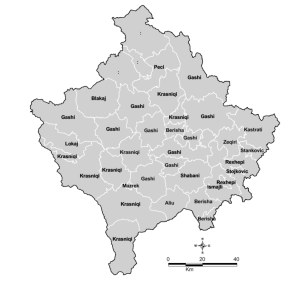 In 2017, the Kosovo Agency of Statistics (ASK) published a [PDF] comprehensive report on the distribution and frequency of given names (emra) and surnames (mbiemra) in Kosovo. The study is based on the 2011 Population Census, covering the resident population, and aims to provide useful information for genealogists, etymologists, and researchers in onomastics.
There are 68,122 distinct given names recorded in Kosovo. The most frequent female name is Fatime, borne by 8,626 individuals, and the most common male name is Bajram, with 6,324 bearers. Between 1940–1960, common given names included Fatime, Emine, Ajshe, Bajram, and Ramadan. During 1961–1980, names such as Agim, Bekim, Fadil, Afërdita, and Ganimete became more frequent. After 1990, names shifted towards distinctively Albanian forms like Egezon, Liridona, Qendresa, Erëza, and Edona.
Kosovo has 26,557 distinct surnames. The most common surname is Krasniqi, with 58,199 individuals, followed closely by Gashi (57,396), and Berisha (43,727). Other top surnames include Morina, Shala, Bytyqi, Hasani, Kastrati, Kryeziu, and Hoti. Surnames largely remain consistent over time, with Krasniqi dominant for most periods, except 1951–1960 and 2001–2011, when Gashi slightly surpassed it.
The report also includes tables showing names and surnames by municipality and even birth month/season, reflecting both demographic and cultural patterns. Overall, this report provides an important statistical foundation for understanding naming patterns, family lineage, and surname distribution in Kosovo.
- Download [PDF] Emrat dhe Mbiemrat në Kosovë by Kosovo Agency of Statistics (2017).
 Ex-Yu Genealogy