Most Macedonian surnames derive from three primary sources: personal names, nicknames, and occupational or descriptive terms. Patronymic formation is particularly dominant, reflecting earlier naming practices in which individuals were identified through their father or ancestor.
Macedonian surnames are most commonly formed with suffixes such as -ski / -evski / -ovski, originally indicating belonging, origin, or descent. During the 19th century, these forms became increasingly common, especially in western Macedonia.
Hereditary surnames became gradually stabilized during the 19th and early 20th centuries under changing Ottoman, Serbian, Bulgarian, and later Yugoslav administrations, which sometimes altered or standardized surname endings in official records.
Dictionary of Surnames among Macedonians (1994)
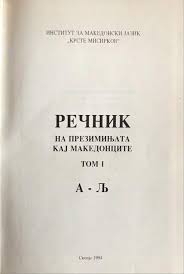 The Речник на презимињата кај Македонците (Dictionary of Surnames among Macedonians, Skopje, 1994), published by the Institute for the Macedonian Language “Krste Misirkov” and edited by Trajko Stamatoski with collaborators Marija Korobar-Belčeva, Marinko Mitkov, and Olga Ivanova, is the most comprehensive scholarly reference on surnames among ethnic Macedonians. Designed as both a linguistic and demographic study, it represents a fundamental starting point for genealogical research in North Macedonia.
The dictionary is primarily based on data from the 1961 population census, supplied by the State Statistical Office and covering individuals who identified as ethnic Macedonians. Approximately 300,000 families were analyzed, making the work one of the largest surname datasets compiled in the region. Because a portion of census data remained unpublished and some populations identified differently at the time, the editors note that certain surnames may be absent—an important consideration for genealogists encountering gaps in records.
Each surname entry follows a structured format especially valuable for family research. Every entry contains the geographic distribution and frequency – listing the settlements and municipalities where a surname appears, together with the total number of individuals and families bearing it. This allows researchers to identify regional concentrations and potential ancestral homelands.
It also contains linguistic analysis – explaining the surname’s base form, origin, grammatical structure, etymology, and suffix formation. The base may derive from a personal name, nickname, or earlier anthroponym, with alternative forms noted when multiple origins are possible.
The study confirms that Macedonian surnames developed from earlier flexible naming systems in which individuals were identified through patronymics rather than fixed hereditary names. Stable surnames became widespread mainly during the 19th and early 20th centuries as administrative recordkeeping expanded.
Macedonian surnames generally fall into several genealogically relevant categories:
- Patronymic surnames, derived from an ancestor’s given name, such as Nikolovski (from Nikola) or Petrov (from Petar), representing descent or family affiliation.
- Occupational surnames, reflecting traditional professions or social roles, for example Kovačevski (blacksmith) or Popovski (priest).
- Nickname or descriptive surnames, originating from physical or personal characteristics used within local communities, such as Belov (“fair, white”) or Golemčev (“big, tall”).
- Toponymic surnames, indicating geographic origin or migration history, linking families to specific towns or regions.
The editors also compare Macedonian naming patterns with neighboring Serbian, Bulgarian, Greek, and Albanian anthroponymic systems, highlighting cross-cultural influences. Centuries of Ottoman presence are reflected in numerous surnames derived from Turkish loanwords, illustrating the layered historical background preserved in family names.
For genealogists, the dictionary demonstrates an essential principle: identical surnames do not necessarily indicate shared ancestry, since many names arose independently in different settlements. By combining linguistic explanation with precise geographic distribution, the work enables researchers to connect surnames with historical migration, regional identity, and family lineage development.
The surname among Macedonians (2022)
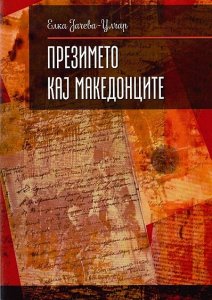 Презимето кај Македонците (The surname among Macedonians, 2022) by Elka Jačeva-Ulčar, offers a comprehensive study of Macedonian surnames as linguistic and historical markers shaped by regional and interethnic contact.
Drawing on dictionaries, field research, and historical sources, the book analyzes surname formation, motivating bases, suffixes, and regional patterns across North Macedonia. Particular attention is given to surnames derived from nicknames—an especially productive source in Macedonian naming traditions—as well as Slavic and non-Slavic influences reflecting Balkan multicultural history.
The work also discusses legal regulation of surnames and includes narratives from surname bearers, statistical data, and a full surname index. For genealogists, it provides valuable insight into surname origins, geographic distribution, and cultural context essential for tracing family histories.
Last edited: 21.03.2026.
 Ex-Yu Genealogy